Showing posts with label verbs. Show all posts

Tuesday, August 4, 2020

Virtual Manipulatives

Lots of things have to be done differently this year.  For example, my beloved Pronoun Dice:


These are a great hands-on tool for practicing verb conjugations.  Students work in groups and use the dice, white boards, and dry erase markers.


But obviously, groups and shared supplies are a no-go right now.  So, I started by googling "virtual dice" and pretty quickly came upon Flippity.net.


I used the Randomizer to make a simple spinner for subjects and verbs.  (Unfortunately, you can't embed flippity tools, but you can link to them.)


Success!  Hopefully some of the flippity tools will be helpful to other teachers, too.

I leave you with this thought:


Saturday, September 1, 2018

Past Participle Practice with Leo sagt


A huge part of German 2 is learning the past tense.  The Perfekt, or conversational past, is formed using a helping verb and past participle.  Many verbs have a regular past participle which is formed following a rule.  

But of course there are exceptions.  And the tough truth is that students have to memorize the past participles of irregular verbs.  It's not always exciting, but it is essential for future success.

To try to make it a little more fun, we've played 4 in a Row and done past participles speed dating in the past.  This year, I tried a new game, Leo sagt (Leo says).

Like so many other good ideas I get, it comes from the #MtBoS (Math Teacher Blogosphere).  Sarah Carter at Math = Love has blogged about playing Slope Dude Says with her algebra students.  It's Simon says, but for math and about slope.  

Translated to German class, it becomes Leo sagt.  Leo is our beloved German online dictionary dict.leo.org.  It is our go-to source for looking up all things German, including plural forms of nouns and past participles of verbs.  Here's how it works:

Leo (me) says a verb, and students move their arms to indicate what category of past participle the verb has.

And, of course, if Leo doesn't say it, we don't do it.  

The first class I tried it in was very enthusiastic, which helped since I tend to be a bit nervous when trying new/silly things, and it went great in all 3 classes!  We did a few practice rounds and then the competition began.  If a student got it wrong, s/he sat down.  They were very good about being honest and policing themselves.  Eventually we got down to one person left, who received a German flag temporary tattoo as a prize.  

Definitely a winner.  Now we just have to see how the Perfekt quiz goes next week...

Saturday, November 11, 2017

German 2: Präteritum

While German 1 has been wrapping up their unit on regular verbs and question words, German 2 has been learning the narrative past (Präteritum).

We started with Präteritum for Regular Verbs:


and then added in irregular verbs:


and haben and sein:


We summarized what we had done so far and took a quiz

before reviewing modal verbs and adding in modals in the Präteritum:

There are some changes I'd like to make to the Präteritum for Modal Verbs notes - slightly different example sentences as well as changes to the review of modals in general, but here are the current notes:  https://drive.google.com/open?id=1rsFJLu5RWOTMSwBAi6XjiqoTS1pC08nQ 


Saturday, October 21, 2017

German 1: Regular Verbs and Question Words

It's been a busy week in German 1!  

While working on the theme of school subjects and university vocabulary, students learned how to conjugate regular verbs:


To practice, students used our pronoun dice and white boards


Students also learned several new interrogative words:


They will be practicing question words by answering questions about themselves, which will prepare them for writing a paragraph soon.


And I'm most proud of this new worksheet, which I created using a great school drawing from


We also watched a great video from Easy German about college life in Germany and the U.S.  Lots of great vocabulary and topics for discussion in there!


Here are the files:


Saturday, September 23, 2017

Three Words: Making Good Progress

Both my German 1 and German 2 classes are making good progress this week, and I felt like I was able to keep on top of things and stay organized pretty well, too.

German 1 has been working on school vocabulary using some Learning Apps:


and has learned the numbers from 0  to 1,000,000,000:


Then, on Friday, I introduced haben and the accusative case:


We've also been keeping up with current events like the start of Oktoberfest and the upcoming German elections.


German 2 has been working with clothing vocabulary, colors, and adjective endings.  The highlight of this had to be describing what my McDonald's Happy Meal toy Minion was wearing and then discovering that his hat pops off, so we can use the verbs ausziehen and anziehen:


On Tuesday, students conjugated the verbs from our current unit.  Then, each table group wrote a sentence in the present tense using one of the verbs.  As a class, we then changed the sentences into the Perfekt.  I liked this practice structure and think I will use it in the future.  My students are starting to get more confident with the Perfekt - yay!


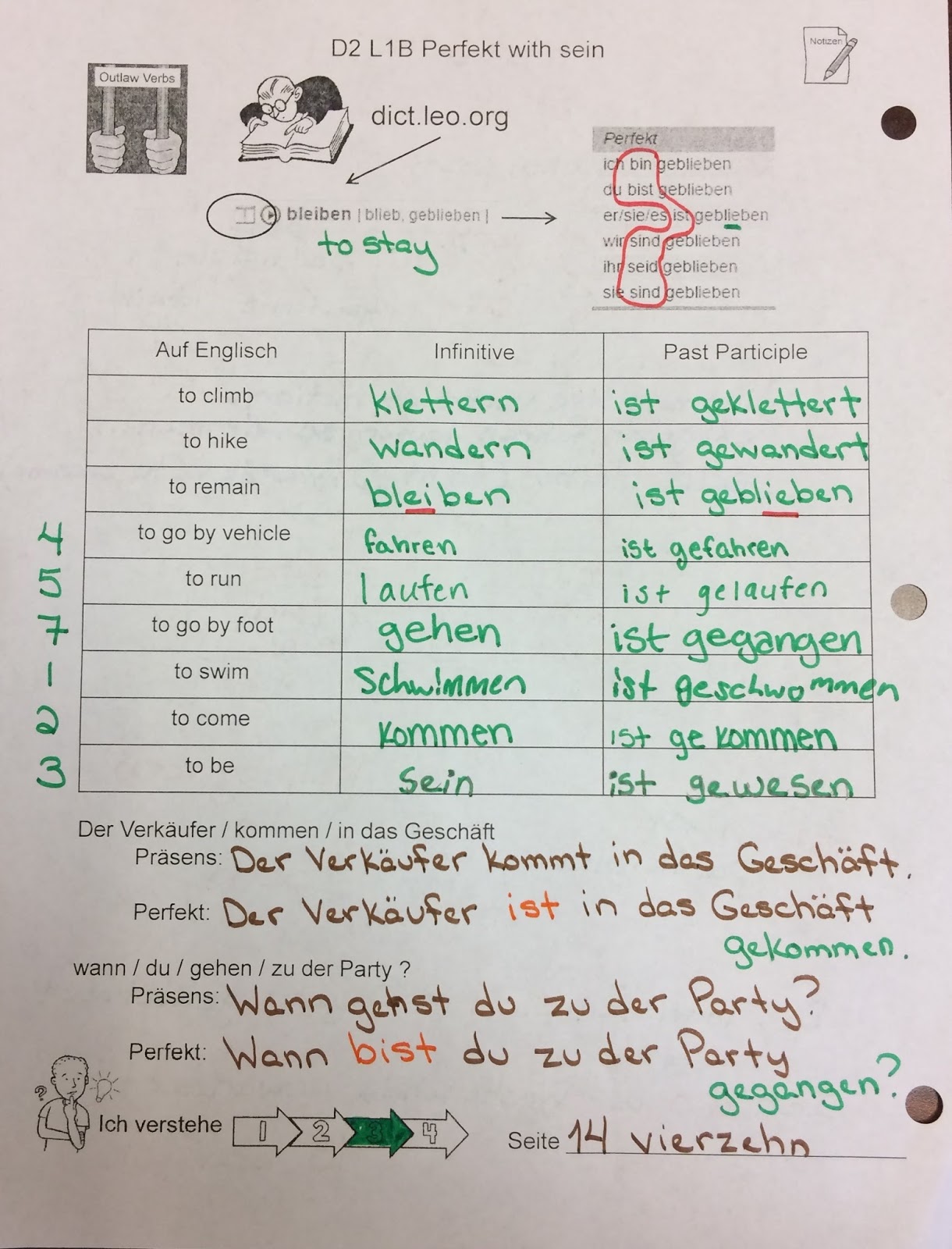
On Thursday, I introduced that Perfekt for verbs that take sein as a helping verb.  It went well, and students had a good initial understanding.  Their assignment was a worksheet which has verbs which take both haben and sein as helping verbs, and that pushed them to think again about how we know which verbs take which helping verb.  


Links to files:


Saturday, September 9, 2017

Three Words: Short but Long

Even though this was a short 4 day week, it still felt surprisingly long.  

It was great to have the long Labor day weekend, and I got to have coffee with my former student teacher, who is now starting his first year of teaching.  I felt well-rested starting the week, but by Friday afternoon I was wiped out and could barely keep my eyes open past 8:00 in the evening!

Still, there were some good things that happened this week.  First and foremost, my trek up the chain of command, which I started last Friday, produced results right away on Tuesday.  Just as I predicted, after about 20 minutes of work by IT during my prep period, my iPad document camera was up and running! 

Hallelujah! So nice to see you, old friend!

I have still been warned that I will have to give up my iPad in October so I need to keep working on a long-term solution.  The document camera I have been considering writing a grant for is on sale right now at Amazon ($85 instead of $99), so I may just buy it myself with money I earned last summer doing curriculum development and (hopefully!) be done with this annual source of frustration.

In other good news, there were lots of stars for 90% or better on the German 1 vocabulary quiz:

and I have my Marzano scale up as well


so the whole back board now looks like this

In German 2, we tried Past Participles Speed Dating for the first time.  
Two out of three classes loved it!  4th period was less impressed, but I think a few people in that relatively small class (20 instead of 30) were just sort of grouchy that day, which set the mood for everyone.  Ah well, you can't please everyone all the time.

And German 1 tried Learning Apps for the first time on Friday.


So, when I look back at it now, it was a tiring week, but a lot of good things did happen.  Happy weekend!

Sunday, April 2, 2017

Separable Prefixes in German 1


One of the big topics for German 1 this unit is separable prefix verbs.  I started out by giving each student a small piece of paper with the 5 prefix verbs from this unit on it:

Their first job was to write the meaning on the back and cut them apart.  Then, when we got to the part of the notes that talked about separable prefix verbs, I had students cut the prefix off of the verb stem and move it to the end of the sentence.  


Then, we did some examples


before talking about inseparable prefix verbs.

Last year I taught separable prefix verbs with modal verbs and in the command form on the same day (what was I thinking?), but based on how poorly students did on the test, that was clearly too much.  So, this time, I divided it into three separate lessons and spent more time reviewing the modal verbs and commands before we added in the prefix verbs.  

(Somehow I don't have a picture of the prefix verbs with modals notes, but here are the command form notes.)


Students definitely liked it better because each lesson was short.  We'll see how they do on the test next week!

Here's the link to the notes: Verbs with Prefixes


Friday, September 30, 2016

Past Participles Speed Dating


File this one under: It's just crazy enough that it might work.

German 2 is learning the Perfekt (conversational past).  After practicing how to form past participles for regular verbs enough that they could recite "ge-verb stem-t" in their sleep, it was time to tackle irregular past participles.

And here we once again come up against one of the unpleasant truths of language learning:

Some things just have to be memorized.  

I've actually come to the conclusion that at least 75% of my job is simply thinking up new and creative ways to trick my students into drilling, drilling, drilling whatever it is they have to memorize.  (The other 25% is split between explaining German grammar and paperwork.)  

There isn't much that's fun or exciting about irregular past participles, but they are necessary.  

While thinking of ways to get my students to practice these past participles, I remembered an activity I had read about recently on my math blogger friend Sarah Carter's blog, Math = Love: Speed Dating.  Sarah was actually featured on NPR's 50 Great Teachers series doing polynomial speed dating.  She credits Kate Nowak with the idea of the speed dating activity.  I've wanted to try speed dating with my German students for a little while.  Could it work for past participles?

On Monday I decided to give it a try.  Just the name caught the interest of some of my more observant students who were reading the agenda board.

Basically, the students each have a card with an infinitive on one side and the English meaning and past participle on the other side.  They move around the room quizzing (dating) each other on past participles and trade cards if they both get the other person's verb correct.  The aim is to date (know the meaning and past participle of) all of the verbs on the checklist.  The materials are pretty basic, just some cards and a check list:

And, it was a hit!  I heard lots of great practice going on, and the students thought it was fun.  It took longer than I expected - the winning speed dater in my first class finished in about 16 minutes.  


I did have the problem in the second class of students checking off verbs they hadn't actually dated (at least I suspect that is what was going on when a student said he was done in 8 minutes).  I dealt with this by requiring that a student tell me a definition and past participle at random from the list in order to be declared the winner.  If the student can't do that correctly, it's back into the dating pool.  I also had some students lose interest after about 10 minutes and spend more time chatting than dating verbs.  It might work better to ditch the checklist and set a timer for 10 minutes, requiring that students date the whole time.  No activity is completely student-proof, I guess.


I wholeheartedly recommend trying speed dating with your students.  Here are my files to get you started: